4/5 - (1 vote)

2025 Easily pass AZ-700 Exam with our Dumps & PDF Test Engine

AZ-700 PDF Pass Leader, AZ-700 Latest Real Test

Microsoft AZ-700 exam is ideal for individuals who have experience in networking and are seeking to expand their knowledge and skills in Azure networking solutions. AZ-700 exam covers a wide range of topics, including Azure virtual networks, Azure DNS, Azure load balancer, Azure traffic manager, and Azure Network Security Groups. It also tests the individuals on their ability to design and implement complex Azure networking solutions.


NO.157 Hotspot Question
You have an Azure subscription that contains 200 virtual machines.
You need to use Azure Network Watcher to identify which virtual machines generate the most network traffic. The solution must minimize administrative effort.
Which prerequisites should you deploy for Network Watcher, and which Network Watcher feature should you use to identify the virtual machines? To answer, select the appropriate options in the answer area.
NOTE: Each correct selection is worth one point.

NO.158 You have the hybrid network shown in the Network Diagram exhibit.

You have a peering connection between Vnet1 and Vnet2 as shown in the Peering-Vnet1-Vnet2 exhibit.

You have a peering connection between Vnet1 and Vnet3 as shown in the Peering -Vnet1-Vnet3 exhibit.

For each of the following statements, select Yes if the statement is true. Otherwise, select No.
NOTE: Each correct selection is worth one point.

NO.159 You have an on-premises network that includes the sites shown in the following table.

Each site is connected to the Internet by a firewall. All sites are connected to an SD-WAN. Each site is configured to propagate routes by using BGP.
You have an Azure subscription that includes a virtual network named Vnet1 that contains a Virtual Network Gateway named Gateway 1.
You create a local network gateway with the configuration shown in the gateway exhibit (Click the Gateway tab.)

You create a Site-to-Site (S2S) connection with the configuration shown in connection exhibit. (Click the Connection tab)

For each of the following statements, select Yes if the statement is true Otherwise, select No.
NOTE: Each correct selection is worth one point.

NO.160 You have the Azure App Service app shown in the App Service exhibit.

The VNet Integration settings for as12 are configured as shown in the Vnet Integration exhibit.

The Private Endpoint connections settings for as12 are configured as shown in the Private Endpoint connections exhibit.

For each of the following statements, select Yes if the statement is true. Otherwise, select No.
NOTE: Each correct selection is worth one point.

NO.161 You are implementing the virtual network requirements for VM Analyze.
What should you include in a custom route that is linked to Subnet2? To answer, select the appropriate options in the answer area.
NOTE: Each correct selection is worth one point.

NO.162 You need to connect Vnet2 and Vnet3. The solution must meet the virtual networking requirements and the business requirements.
Which two actions should you include in the solution? Each correct answer presents part of the solution.
NOTE: Each correct selection is worth one point.


NO.163 You have an Azure Front Door instance that provides access to a web app. The web app uses a hostname of www.contoso.com.
You have the routing rules shown in the following table.

Which rule will apply to each incoming request? To answer, select the appropriate options in the answer area.
NOTE: Each correct selection is worth one point

NO.164 You have an Azure subscription that contains an Azure App Service web app named WebApp1 and an Azure Front Door profile named FDProfile1. FDProfile1 forwards requests addressed to
https://www.contoso.com to WebApp1.
You need to ensure that only requests addressed to https://www.contoso.com/users/* are forwarded to WebApp1.
What should you modify in FDProfile1?


NO.165 You have an Azure subscription that contains the resources shown in the following table.

The virtual network topology is shown in the following exhibit.

Firewall1 is configured as shown in following exhibit.

FirewallPolicy1 contains the following rules:
* Allow outbound traffic from Vnet1 and Vnet2 to the internet.
* Allow any traffic between Vnet1 and Vnet2.
No custom private endpoints. service endpoints. routing tables, or network security groups (NSGs) were created. For each of the following statements, select Yes if the statement is true. Otherwise, select No. NOTE:
Each correct selection is worth one point.

NO.166 Your on-premises network contains an Active Directory Domain Services {AD DS) domain named contoso.
com that has an internal certification authority (CA).
You have an Azure subscription.
You deploy an Azure application gateway named AppGwy1 and perform the following actions:
* Configure an HTTP listener.
* Associate a routing rule with the listener.
You need to configure AppGwy1 to perform mutual authentication for requests from domain-joined computers to contoso.com.
Which four actions should you perform in sequence? To answer, move the appropriate actions from the list of actions to the answer area and arrange them in the correct order.

NO.167 Your on-premises network contains an Active Directory Domain Services {AD DS) domain named contoso.com that has an internal certification authority (CA).
You have an Azure subscription.
You deploy an Azure application gateway named AppGwy1 and perform the following actions:
* Configure an HTTP listener.
* Associate a routing rule with the listener.
You need to configure AppGwy1 to perform mutual authentication for requests from domain-joined computers to contoso.com.
Which four actions should you perform in sequence? To answer, move the appropriate actions from the list of actions to the answer area and arrange them in the correct order.

NO.168 Your company has an Azure virtual network named Vnet1 that uses an IP address space of 192.168.0.0/20. Vnet1 contains a subnet named Subnet1 that uses an IP address space of 192.168.0.0/24.
You create an IPv6 address range to Vnet1 by using a CIDR suffix of /48.
You need to enable the virtual machines on Subnet1 to communicate with each other by using IPv6 addresses assigned by the company. The solution must minimize the number of additional IPv4 addresses.
What should you do? To answer, select the appropriate options in the answer area.
NOTE: Each correct selection is worth one point.

NO.169 You create NSG10 and NSG11 to meet the network security requirements.
For each of the following statements, select Yes it the statement is true. Otherwise, select No.
NOTE: Each correct selection is worth one point.

NO.170 You need to connect an on-premises network and an Azure environment. The solution must use ExpressRoute and support failing over to a Site-to-Site VPN connection if there is an ExpressRoute failure.
What should you configure? To answer, select the appropriate options in the answer area.
NOTE: Each correct selection is worth one point.

NO.171 You have the Azure virtual networks shown in the following table.

You have the Azure resources shown in the following table.

You need to check latency between the resources by using connection monitors in Azure Network Watcher.
What is the minimum number of connection monitors that you must create?


NO.172 You have Azure App Service apps in the West US Azure region as shown in the following table.

You need to ensure that all the apps can access the resources in a virtual network named Vnet1 without forwarding traffic through the internet-How many integration subnets should you create?


NO.173 Note: This question is part of a series of questions that present the same scenario. Each question in the series contains a unique solution that might meet stated goals. Some question sets might have more than one correct solution, while others might not have a correct solution.
After you answer a question in this section, you will NOT be able to return to it. As a result, these questions will not appear in the review screen.
You have an Azure subscription that contains the following resources:
* A virtual network named Vnet1
* A subnet named Subnet1 in Vnet1
* A virtual machine named VM1 that connects to Subnet1
* Three storage accounts named storage1, storage2. and storage3
You need to ensure that VM1 can access storage1. VM1 must be prevented from accessing any other storage accounts.
Solution: You create a network security group (NSG). You configure a service tag for MicrosoftStorage and link the tag to Subnet1.
Does this meet the goal?


NO.174 You have an Azure virtual network named Vnet1 that hosts an Azure firewall named FW1 and 150 virtual machines. Vnet1 is linked to a private DNS zone named contoso.com. All the virtual machines have their name registered in the contoso.com zone.
Vnet1 connects to an on-premises datacenter by using ExpressRoute.
You need to ensure that on-premises DNS servers can resolve the names in the contoso.com zone.
Which two actions should you perform? Each correct answer presents part of the solution.
NOTE: Each correct selection is worth one point.


NO.175 You have two Azure subscriptions.
You need to perform the following actions in the East US Azure region of each subscription:
* Deploy 50 virtual machines to availability zone 1.
* Deploy 50 virtual machines to availability zone 2.
* Deploy 50 virtual machines to availability zone 3.
What is the minimum number of virtual networks and /25 subnets you should create? To answer, select the appropriate options in the answer area.
NOTE: Each correct selection is worth one point.

NO.176 You have an Azure subscription that contains a dual-stack virtual network named VNet1. VNet1 has the following IP address spaces:
* IPv4:192.168.0.0/24
* IPv6: fd0adbftdeca: deed: y48
You plan to deploy an Azure VPN gateway and multiple virtual machines to VNet1.
You need to configure the subnet masks for VNet1. The solution must meet the following requirements:
* Maximize the number of usable IP addresses.
* Support the deployment of the VPN gateway and the virtual machines.
Which subnet mask should you use for each address space? To answer, select the appropriate options in the answer area.
NOTE: Each correct selection is worth one point.

NO.177 Case Study 1 – Litware. Inc
Overview
Litware. Inc. is a financial company that has a main datacenter in Boston and 20 branch offices across the United States. Users have Android, iOS, and Windows 10 devices.
Existing Environment:
Hybrid Environment
The on-prernises network contains an Active Directory forest named litwareinc.com that syncs to an Azure Active Directory (Azure AD) tenant named litwareinc.com by usinq Azure AD Connect.
All the offices connect to a virtual network named Vnetl by using a Site-to-Site VPN connection.
Azure Environment
Litware has an Azure subscription named Sub1 that is linked to the litwareinc.com Azure AD tenant. Sub1 contains resources in the East US Azure region as shown in the following table.
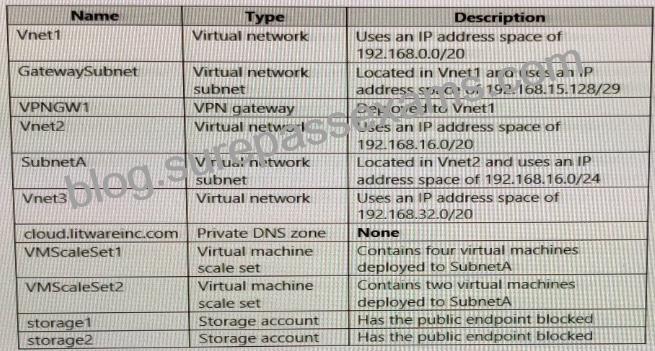
A diagram of the resource in the East US Azure region is shown in the Network Diagram exhibit.
There is bidirectional peering between Vnet1 and Vnet2. There is bidirectional peering between Vnet1 and Vnet3. Currently, Vnet2 and Vnet3 cannot communicate directly.
Azure Environment Diagram

Requirements:
Business Requirements
Litware wants to minimize costs whenever possible, as long as all other requirements are met.
Virtual Networking Requirements
Litware identifies the following virtual networking requirements:
– Direct the default route of 0.0.0.0/0 on Vnet2 and Vnet3 to the
Boston datacenter over an ExpressRoute circuit.
– Ensure that the records in the cloud.litwareinc.com zone can be
resolved from the on-premises locations.
– Automatically register the DNS names of Azure virtual machines to the cloud.litwareinc.com zone.
– Minimize the size of the subnets allocated to platform-managed
services.
– Allow traffic from VMScaleSet1 to VMScaleSet2 on the TCP port 443
only.
Hybrid Networking Requirements
Litware identifies the following hybrid networking requirements:
– Users must be able to connect to Vnet1 by using a Point-to-Site (P2S) VPN when working remotely. Connections must be authenticated by Azure AD.
– Latency of the traffic between the Boston datacenter and all the
virtual networks must be minimized.
– The Boston datacenter must connect to the Azure virtual networks by
using an ExpressRoute FastPath connection.
– Traffic between Vnet2 and Vnet3 must be routed through Vnet1.
PaaS Networking Requirements
Litware identifies the following networking requirements for platform as a service (PaaS):
– The storage1 account must be accessible from all on-premises
locations without exposing the public endpoint of storage1.
– The storage2 account must be accessible from Vnet2 and Vnet3 without
exposing the public endpoint of storage2.
Drag and Drop Question
You need to prepare Vnet1 for the deployment of an ExpressRoute gateway.
The solution must meet the hybrid connectivity requirements and the business requirements.
Which three actions should you perform in sequence for Vnet1? To answer, move the appropriate actions from the list of actions to the answer area and arrange them in the correct order.


Microsoft Azure platform is becoming increasingly popular, and with it, the demand for qualified professionals who can design and implement Azure networking solutions is also on the rise. By passing the Microsoft AZ-700 exam, you can demonstrate your expertise in Azure networking solutions and enhance your career opportunities in this field.


AZ-700 Dumps Ensure Your Passing: https://www.surepassexams.com/AZ-700-exam-bootcamp.html


Related Links: www.stes.tyc.edu.tw myportal.utt.edu.tt www.stes.tyc.edu.tw www.stes.tyc.edu.tw myportal.utt.edu.tt www.stes.tyc.edu.tw

Leave a Reply

Your email address will not be published. Required fields are marked *

Enter the text from the image below